
If you're Googling "restaurant booking system Australia," you're probably past the "do we need one" question and into "which one." That's the harder question, because most of these companies don't put real numbers on their websites, and the ones that do use different units — per month, per cover, per SMS, per booking — that don't compare cleanly.
This is a practical rundown of what four systems appear to cost and who each one suits, based on each vendor's public pricing pages and third-party comparison sources as of September 2026. Different sources sometimes disagree on a vendor's exact numbers or which tier counts as "entry level" — where that happened, we've flagged it below. Treat everything here as a starting point for your own research and quote request, not a locked-in quote.
What actually matters when comparing
Before the numbers, five things decide whether a system fits a small-to-mid Australian venue:
- Pricing model. Flat monthly fee, or a base fee plus a per-cover/per-booking charge? A per-cover fee sounds small until a 60-seat restaurant does 3,000 covers a month.
- Contract length. Month-to-month vs. annual lock-in matters more than the sticker price if you're not sure the system will stick.
- Setup and switching cost. Some platforms charge a setup fee on top of the subscription. Ask upfront.
- What's actually included at your price point, not the platform's top tier. Deposits, SMS, and multi-location support are often gated behind a higher plan than the one in the marketing headline.
- When the no-show protection actually asks for money. A deposit collected at the moment of booking is a genuine no-show deterrent, but it also turns a 30-second booking into a checkout — and asking someone to pay before they've even confirmed they're coming is exactly the kind of extra step that makes people abandon a form. A system that only charges a card on file after a no-show happens protects the same revenue without putting that friction in front of every single booking.
The comparison
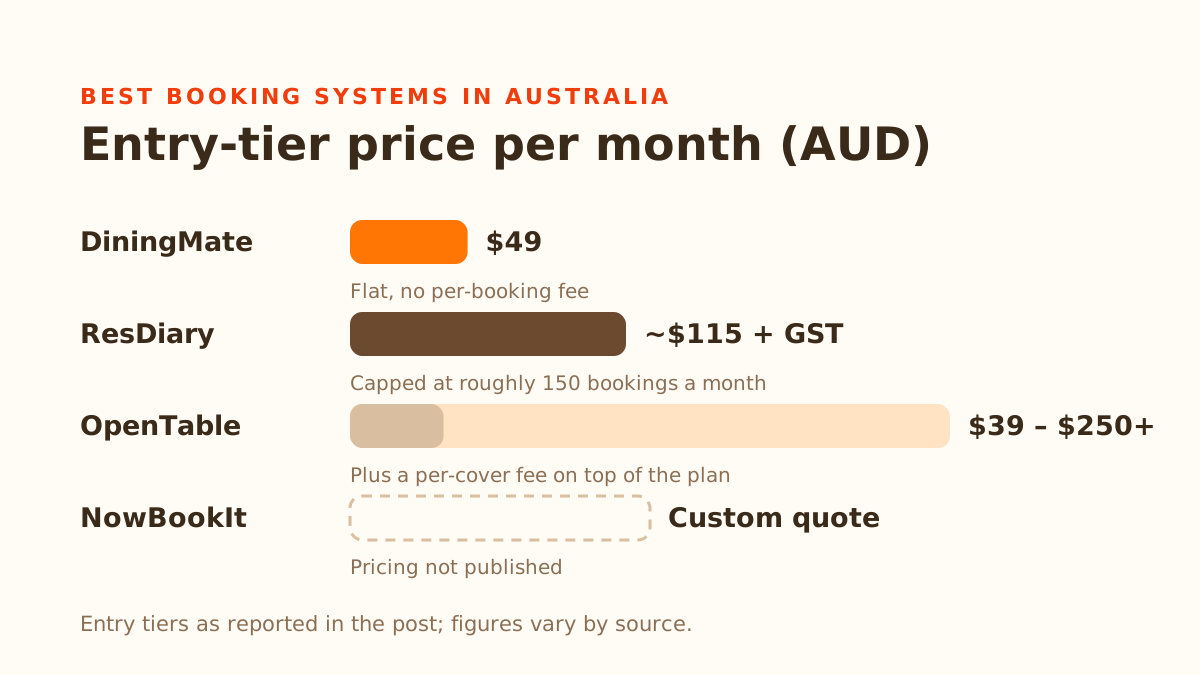
| System | Starting price (AUD) | Pricing model | Notable at entry tier |
|---|---|---|---|
| ResDiary | ~$115/month + GST (reported figures vary) | Flat, capped bookings (~150/month on entry tier) | ~$129 one-off setup fee; SMS and deposits are paid add-ons |
| NowBookIt | Custom quote | Flat, no per-cover fee (pricing not published) | 6,000+ AU/NZ venues; must book a demo for pricing |
| OpenTable | Tiered, roughly $39–$250+/month + per-cover fee | Base fee + per-cover | Marketplace exposure to OpenTable's diner network |
| DiningMate | $49/month flat | Flat, no per-booking fee | AI natural-language booking, automatic table assignment, no-show protection |
A few things worth calling out row by row:
ResDiary scales by booking volume rather than a single flat number — its entry Connect tier is reported around $115/month and caps out at roughly 150 bookings a month, which a busy 40-seat restaurant can hit comfortably, pushing you to a higher Express tier. Add-ons (SMS, deposits, POS integration) appear to be priced separately, so the effective monthly cost is likely higher than the headline figure once you add what most restaurants actually use — get an itemised quote before comparing.
NowBookIt has the largest installed base on this list — north of 6,000 venues across Australia and New Zealand — but doesn't publish pricing anywhere. You'll need to book a demo and get a quote based on booking volume and features, which makes it hard to compare on price alone before talking to sales.
OpenTable doesn't clearly publish Australian pricing on its own site, and the tiered figures we found across third-party sources didn't fully agree with each other — some cite an entry "Basic" tier well under $249/month, with $249+ looking more like a mid-tier ("Core") price once you add the per-cover fee. Don't take the number in the table above as OpenTable's true starting price — get a quote directly from OpenTable before comparing. The per-cover fee is the detail to model carefully either way — it scales with your restaurant's success, which is exactly what a flat-fee competitor will point out, but OpenTable's diner marketplace is a real distribution channel that flat-fee tools don't offer.
DiningMate, a Melbourne-founded company, is built for small-to-mid-sized restaurants rather than large enterprise groups. It's a flat $49/month per location — no per-booking or per-cover fee, no contract, and a 3-month free trial. You can run multiple locations under one account, each billed separately rather than at a bundled multi-site rate, but don't expect the dedicated account manager or custom onboarding a larger group might get elsewhere.
At $49 you get the full feature set, not a stripped entry tier: guests can book through a traditional form or by typing or speaking something like "table for 2 tomorrow night" — the AI natural-language option is there alongside the standard form, not a replacement for it, and it follows the same conversational-input shift showing up across consumer software generally. Either way, DiningMate handles automatic table assignment based on party size and table connections, plus real-time dashboard updates. No-show protection works via a card held on file — charged only if a guest no-shows or cancels late, so nothing changes hands just to hold the table.
The natural-language parser also isn't English-only — it understands Korean, Chinese, and French requests too (e.g. "2명 이번주 토요일 저녁", "明天晚上两个人", "demain soir pour 4"), useful if some of your guests would rather not type stilted English. That's the parser understanding a language, though, not a translated page — the booking form itself is still English-only today.
Which one fits your venue
- Coming off phone bookings entirely, want the simplest flat price: DiningMate — flat $49/month with no per-cover fee and a no-card-required trial.
- Need SMS reminders or deposits and don't mind those living in a higher tier: ResDiary with add-ons — confirm current pricing directly.
- High booking volume, want a big diner marketplace for discovery: OpenTable, accepting the per-cover fee as a customer-acquisition cost rather than pure software cost.
- Guests who'd rather type a booking in Korean, Chinese, or French than in English: DiningMate's AI booking bar understands requests in those languages today, on top of English — worth testing during the trial if that's relevant to your guest base.
- Large group or enterprise operation, need a dedicated account manager: NowBookIt or ResDiary's higher tiers, after getting a proper quote.
Before you commit
Ask every vendor these three questions, regardless of what's on their pricing page: what's the actual monthly cost once I add the features I'll use on day one, is there a setup fee, and can I cancel month-to-month if it doesn't work out. The answers separate the real flat-fee tools from the ones where the advertised price is just the starting point of a longer conversation.