If you searched for a free restaurant booking system, you're probably trying to avoid paying for something you're not sure is worth it yet. That's a reasonable instinct. But the honest answer is: genuinely free options exist, they just aren't what most restaurants mean when they picture "a booking system" — and the dedicated platforms you've probably heard of don't have permanent free plans at all. Here's what's actually on offer at each price point, so you can work out which gap you're trying to close.
What's actually free
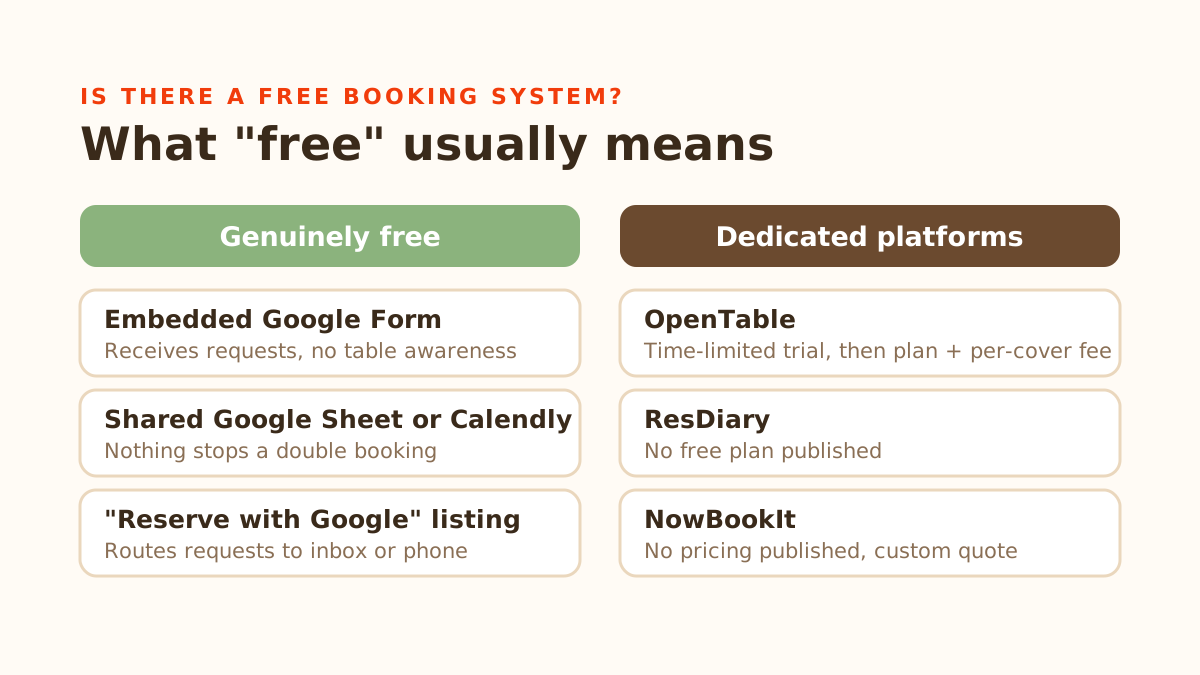
The truly free tier of restaurant booking looks like this: a Google Form embedded on your website, a shared Google Sheet or Calendly link, or a "Reserve with Google" listing that routes requests to your inbox or phone. These cost nothing and take an afternoon to set up.
What you don't get: any awareness of your actual table layout, so nothing stops two parties from being booked into the same slot if a staff member doesn't cross-check manually. No automatic confirmation or reminder emails beyond whatever the form tool sends by default. No record of no-shows or repeat guests unless someone manually maintains that separately. And no way for a guest to book outside a rigid form — if someone wants to text "table for 4 tomorrow around 7," they're calling you instead, which is exactly the workload a booking system is supposed to remove.
For a very low-volume venue — a handful of bookings a week — this can genuinely be enough, and there's no reason to pay for more. The problem shows up once volume climbs: a spreadsheet doesn't stop double-bookings by itself, and the coordination it takes to keep it accurate scales with how busy you get, which is exactly when you have the least spare attention for it.
What the named platforms actually offer instead of "free"
If you've been comparing OpenTable, ResDiary, or NowBookIt hoping one of them has a hidden free tier, it's worth being clear about what they actually offer, because it's not that:
- OpenTable doesn't have a free ongoing plan — it runs a time-limited free trial on its entry plan, after which you're on a monthly subscription plus a per-cover fee for diners seated through its network. The free trial is real, but it's a trial, not a tier you can stay on.
- ResDiary likewise doesn't publish a free plan; its pricing starts as a flat monthly subscription with no free ongoing option, and the exact number depends on your venue size and which features you need.
- NowBookIt doesn't publish pricing at all — free or otherwise. You get a custom quote after a sales conversation, which makes it hard to know upfront whether any trial period is even offered.
The pattern across all three: a free trial window to test the product, then a paid plan once you decide to keep using it. None of them are free long-term, and the trial length and card requirement vary enough that it's worth checking directly rather than assuming.
The question that actually matters
"Is it free" is the wrong first question, because none of the dedicated platforms are, and the genuinely free options (forms, spreadsheets) aren't really booking systems — they're just a way to receive requests. The more useful question is: what does my current process actually cost me, even if no invoice says so?
If a host or manager spends twenty minutes a night on the phone taking bookings, that's real labour cost, even though it doesn't show up as a software line item. If double-bookings happen a few times a month because two people wrote in the same slot on a paper diary, that's lost covers and an awkward conversation with a guest — also a real cost. Free tools don't remove that work; they just move where it happens.
What a trial period is actually for
Since every real booking platform gates access behind a trial rather than a permanent free tier, the trial is where the actual evaluation happens — and it's worth treating it as more than a formality. During any trial, worth checking:
- Does it stop double-bookings on its own, or does someone still need to manually check a floor plan before confirming? This is the core job a booking system exists to do.
- How long is the trial, and does it require a card upfront? A longer trial without a card commitment gives you more room to actually see busy nights, not just quiet ones, before deciding.
- What happens to your bookings and guest history if you cancel during or after the trial? Ask this before you input real data, not after.
- Can guests actually use it the way they already communicate, or does it force everyone into one rigid form? If a meaningful share of your guests would rather text a request in plain language than fill out a form, that's worth testing directly rather than assuming a form is good enough.
DiningMate's approach to this is a flat $49/month once the trial ends, with a 3-month free trial that doesn't require a card to start — long enough to run it through a full month of normal trading rather than a single quiet week. During the trial you get the full product: automatic table assignment based on party size and how your tables connect, no-show protection where a card is held on file and only charged if a guest doesn't show or cancels late, and the option for guests to book by typing or speaking a plain-language request in English, Korean, Chinese, or French instead of filling out a form. It's not free forever — but a 3-month, no-card trial is close enough to free that you can genuinely test whether it earns its $49 before you're asked to pay anything.
The honest takeaway: if your volume is low enough that a spreadsheet works, don't pay for anything yet. Once double-bookings or phone time start costing you more than $49 a month in lost covers or staff time, the question stops being "is there a free option" and becomes "which trial actually shows me what I'll be paying for" — and that's a test worth running before you commit either way.