If you take most of your bookings by phone, you probably have a gut feeling about how much time it eats up — but a gut feeling isn't something you can act on. "It feels busy" doesn't tell you whether the real cost is 20 minutes a night or two hours. This post is a way to actually put a number on it, using your own call volume rather than an industry average that may not apply to your restaurant.
Why the estimate matters more than a generic statistic
Every restaurant's phone load is different depending on cuisine, location, and how well-known you are for walk-ins versus bookings. A generic "restaurants lose X hours a week to phone calls" statistic is close to useless for deciding whether it's worth changing anything for your restaurant. What's actually useful is a rough calculation you can do in five minutes with numbers you already know.
The calculation
Start with three numbers, estimated for your busiest night (Friday or Saturday is usually the worst case):
- Calls per night. Count them for one shift, or ask whoever answers the phone to tally it — most staff can give you a rough number without much thought ("maybe 15 on a Saturday").
- Minutes per call. This isn't just "hello, table for four, see you then." It's: stop what you're doing, find the diary or tablet, check if the time and party size actually fit your floor plan, write it down, confirm back to the caller, and get back to what you were doing. Two to four minutes is typical once you count the full interruption, not just the talking.
- Who's answering. This is the number that matters most, because the cost isn't really time — it's whose time. If it's the person running the floor or expediting food, a two-minute call doesn't cost two minutes; it costs however long it takes them to physically stop, answer, and get back into the rhythm of what they were doing. Many owners put this closer to five minutes of real disruption per call during service, even if the call itself was short.
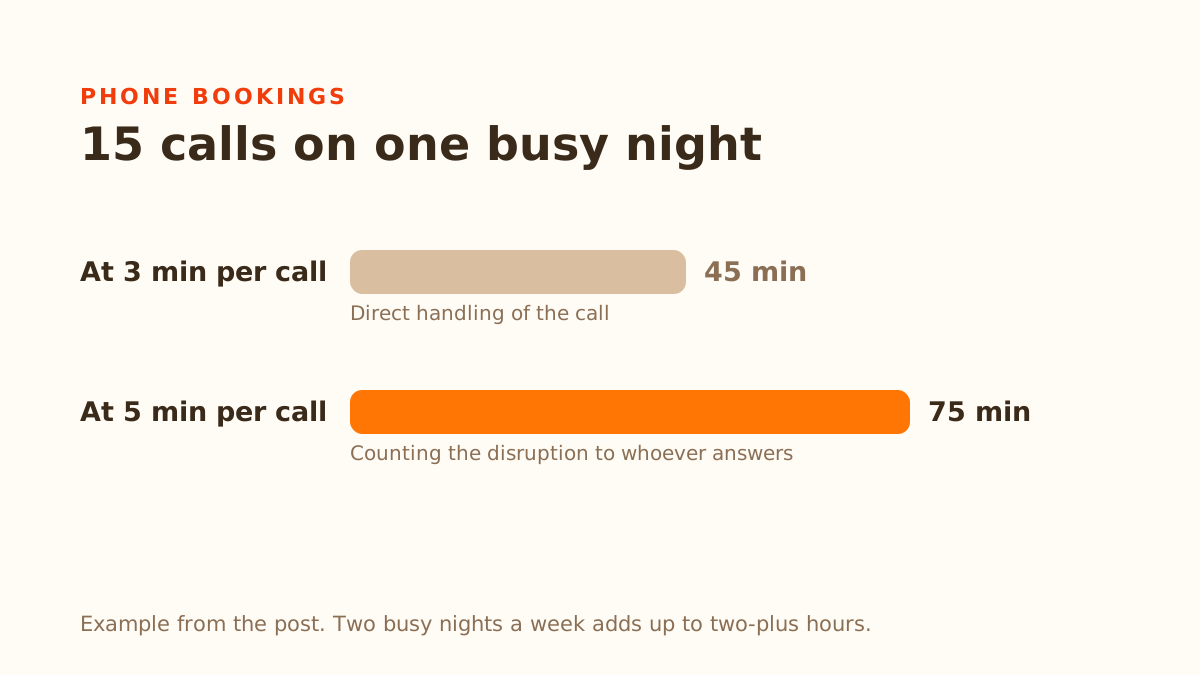
Multiply calls × minutes, and you have a rough per-night number. Fifteen calls at three minutes each is 45 minutes of direct handling — but if each one actually costs five minutes of disrupted attention because of who's answering, that's 75 minutes on a single shift. Do that for a Friday and Saturday and you're looking at two-plus hours a week, every week, that never shows up as a line item anywhere.
Where the real cost hides
The multiplication above is only the part you can count. Three things make the real number worse than the arithmetic suggests:
Calls don't arrive evenly. They cluster right when you're busiest — 6pm to 8pm on a Saturday is both your highest call volume and the worst possible time for anyone to step away from the floor. The cost isn't the average minute; it's the minute you can least afford.
Interruption cost compounds. Getting pulled out of expediting food or running a floor and back in isn't free even after the call ends — there's a few seconds (or more) of re-orientation each time. Fifteen short interruptions aren't the same as one 45-minute block of focused work; they're worse.
Mistakes made while rushed don't show up in the tally. A booking taken in the middle of a rush, written on the corner of a ticket or typed quickly into a notes app, is more likely to have the wrong time, wrong party size, or end up double-booked against another table. That's not staff time lost on the call — it's staff time lost later, sorting out the mix-up, sometimes in front of the guest.
What actually reduces this, and what doesn't
Not every fix here is "get an online booking system." A few things worth separating:
- If most of your calls are regulars rebooking, staff time on the call itself is already low because they know the guest and the usual order — the system doesn't help much here beyond having a record.
- If your calls are mostly at the one or two peak hours, the fix that matters is reducing how many calls land in that window, which means giving guests another way to book that doesn't involve calling during service at all — a web form they can fill out from home at 9am or 11pm doesn't compete with your Saturday rush.
- If the actual bottleneck is checking table availability by eye, then even moving to an online form doesn't fully fix it unless table assignment is also checked automatically against your floor plan and table connections — otherwise you've just moved the same manual check from phone call to inbox.
One thing worth noting: even bookings your staff still take by phone can get faster if the system recognises a returning guest and pre-fills their details, instead of someone typing a name, phone number and email from scratch every time — the call doesn't disappear, but the admin work after it shrinks.
Doing the math for your own numbers
Before changing anything, it's worth running the calculation above honestly, including the "who's answering" multiplier — that's usually the part owners under-count. If your number comes out under, say, 30 minutes a week, a phone-only setup might genuinely be fine for your volume; there's no need to add a system to solve a problem that's small in practice. If it comes out closer to a few hours a week, every week, that's a recurring labour cost worth weighing against whatever it would take to shift even half those calls off the phone during service.
DiningMate runs a flat $49/month with a 3-month free trial that doesn't require a card to start, specifically so you can run your actual busy nights through it and see whether the call volume during service actually drops — rather than estimating it from a sales page.