Email reminders are free, or close enough to free that nobody thinks about the cost. SMS is different — every message has a real, per-unit price, and if you've ever gotten a quote from a texting provider and felt like the numbers didn't quite add up, you're not imagining it. This is the actual math, so you can work out whether SMS reminders are worth it for your restaurant before you sign up for anything.
Why SMS even comes up
Email reminders work well for most bookings, but SMS has one advantage nothing else matches: open rates. A text message gets read within minutes in the vast majority of cases, where an email can sit unread in an inbox until it's too late to matter. For a restaurant chasing down no-shows on a packed Saturday night, that speed is the entire appeal. The problem is that the same channel that makes SMS reliable also makes it expensive — carriers charge per message, and there's no way around that.
How SMS is actually billed
SMS pricing in Australia is per-segment, not per-message. A standard GSM-7 encoded text message holds 160 characters before it splits into a second segment, and you get billed for each segment separately. This matters more than it sounds like it should: a reminder that includes the restaurant name, the booking time, a cancellation link, and a sign-off can creep past 160 characters without anyone noticing, quietly doubling the cost of every single send.
Roughly, the market breaks down into three tiers:
- Twilio (direct): around A$0.05 per segment. No minimum commitment, but no volume discount either unless you're sending at real scale.
- Australian aggregators (MessageMedia, ClickSend, SMSGlobal and similar): around A$0.02–0.04 per segment, but usually only at that rate once you commit to a minimum monthly volume.
- WhatsApp Business utility templates: similar per-message pricing to the aggregators (roughly A$0.02–0.04), except that any message sent within 24 hours of a guest's own message to you is free. For a one-way reminder with no prior guest message, that free window doesn't apply, so the cost is close to SMS.
There's close to no economy of scale here until you're sending at a volume that justifies an aggregator contract. A restaurant sending a few hundred reminders a month pays close to the same per-segment rate as one sending a dozen.
Doing the math for your own restaurant
The formula is simple: monthly bookings × reminder rate × segments per message × cost per segment.
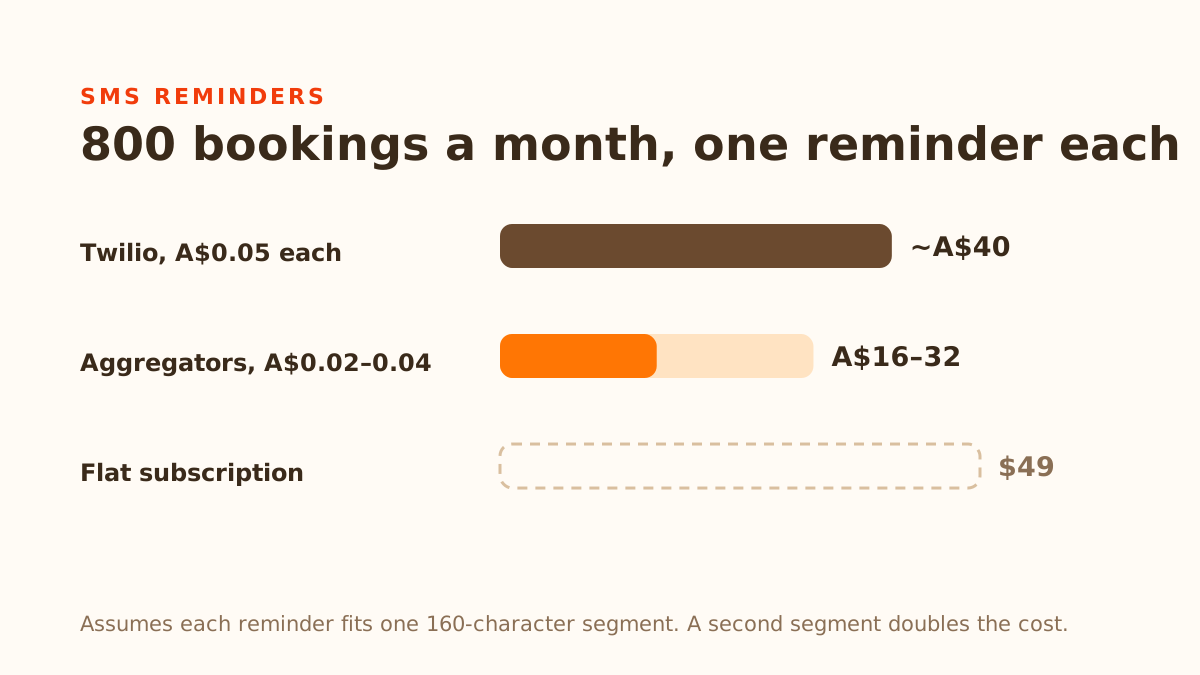
Take a mid-size restaurant doing 800 bookings a month, assuming every confirmed booking gets one reminder and each one fits in a single segment:
- At Twilio's direct rate (~A$0.05/segment): roughly A$40/month.
- At an aggregator's committed-volume rate (~A$0.02–0.04/segment): roughly A$16–32/month.
Against a flat $49/month software subscription — the kind most small restaurants are now on, with no per-booking fees — that's somewhere between a third and most of the entire subscription cost, just for reminders. If your reminder text runs long enough to spill into a second segment, double all of those numbers. And none of this includes the admin overhead of comparing providers, setting up sender IDs, or handling delivery failures when a guest's number is wrong or disconnected.
Where it's worth paying for, and where it isn't
SMS cost makes the most sense when the downside of a no-show is genuinely expensive and email isn't catching it. That's usually:
- Large parties. A six-top no-show on a Saturday is a bigger loss than a table for two, so the reminder cost is easy to justify relative to the revenue at risk.
- Prime weekend slots. An empty 7:30pm Friday table often can't be resold on short notice. A missed table on a quiet Tuesday afternoon usually can.
- Guests who haven't engaged with the confirmation email. If someone opened the confirmation and clicked through to add it to their calendar, they've already demonstrated they've seen it — a second, paid channel adds little.
It's harder to justify for small parties, off-peak times, or guests who've already shown engagement with the booking. Sending SMS to every single booking regardless of risk is the most expensive way to run the policy, and it's rarely where the return is highest.
A free alternative worth trying first
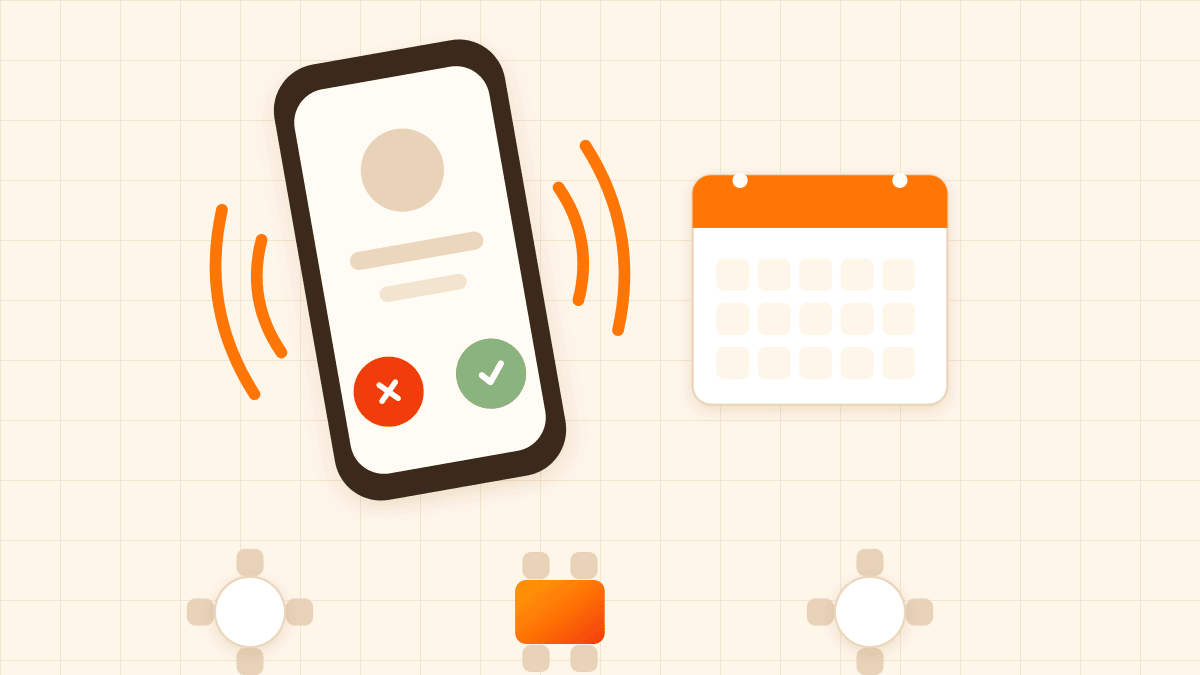
Before paying per-message for SMS, it's worth exhausting what a free channel can already do. A confirmation or reminder email with a calendar invite attached (an .ics file, or "Add to Google/Outlook/Apple Calendar" buttons) puts the booking directly into a guest's phone calendar, where it shows up with its own native alarm — no inbox required, no cost per send. It won't get read in the first five minutes the way a text does, but it solves the same root problem the SMS fixes: a guest who intended to come and simply forgot. DiningMate includes automatic email reminders (sent once, 24 hours to 2 hours before a confirmed booking) and calendar-invite buttons on every plan at no extra cost, which covers a meaningful share of what a paid SMS add-on would otherwise be doing.
SMS itself isn't part of the product today — if your restaurant decides the economics above are worth it for your specific booking mix, you'd be looking at a direct integration with a provider like the ones above. The numbers in this article are exactly what you'd want to check before doing that: get your own average segment count, confirm the aggregator's actual committed-volume rate (quoted rates vary and change), and multiply by your real monthly booking count rather than a rough estimate.
The bottom line
SMS reminders work, but they're not free, and the per-segment pricing model means the cost scales linearly with every booking you send one to. For most small and mid-size restaurants, the right first move is making sure email reminders and calendar invites are doing as much of the job as they can — free, automatic, no segment-counting required — and reserving SMS, if you add it at all, for the specific bookings where the cost of a no-show is genuinely high enough to justify a few cents a message.