"AI-powered booking" shows up in a lot of restaurant software marketing right now, and it rarely means the same thing twice. Sometimes it's a chatbot bolted onto a website. Sometimes it's a voice assistant that answers the phone. Sometimes it's just a form with a sparkle icon next to it. If you're evaluating a booking system and keep seeing the phrase, it's worth being specific about what it actually does before deciding whether it matters for your restaurant.
This post describes one specific version of it — the natural language booking feature on DiningMate's guest booking page — and is honest about where it helps and where it doesn't.
What this actually is
On DiningMate's guest-facing booking page, instead of only offering a structured form (pick a date, pick a time, enter guest count), there's also a single text box guests can type or speak into. A guest can write something like "4 adults, Saturday evening, window side please" or "Birthday dinner for 6 next Friday at 7pm" instead of filling out separate fields one at a time.
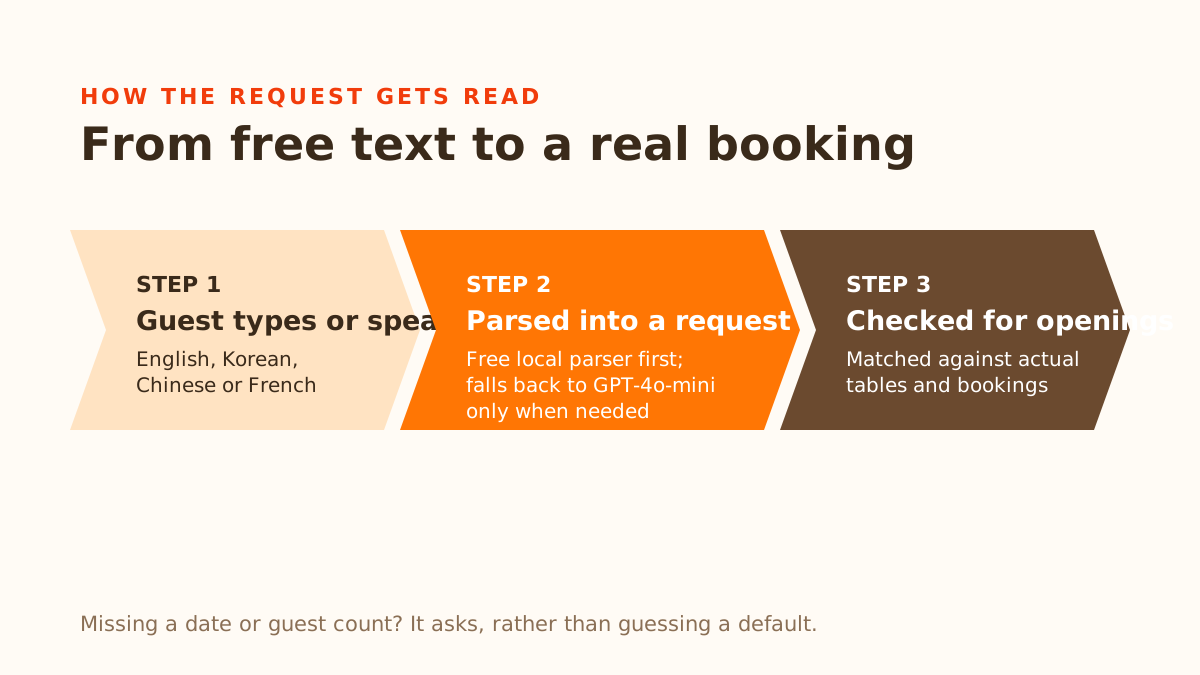
Under the hood, that text gets turned into a structured booking intent — date, time, number of adults, number of kids, highchairs needed, and any notes. Two things make this worth doing rather than just a form with extra steps:
It resolves relative dates correctly. "Tomorrow," "next Friday," "this Saturday" all get converted against the actual calendar, not guessed. A guest typing "next Friday" on a Thursday means something different from the same phrase on a Monday, and getting it wrong creates a wrong booking or an annoyed guest who has to start over.
It understands more than one language. The parser handles requests in English, Korean, Chinese, and French. A guest can type in whichever language they're comfortable in, and any free-text notes (allergies, occasion details, seating requests) get translated into English for your staff to read on the admin side. You don't need a bilingual host on shift to understand what a guest asked for.
What happens after the text is parsed
Two more things worth knowing, because they're the part that actually prevents a bad booking rather than just a cute input box:
It checks real availability, not a guess. Once date, time, and guest count are extracted, the system checks that request against your actual table layout and existing bookings for that date — the same availability check the structured form uses. If the exact time a guest asked for is full, they're shown the nearest open times instead of being told "not available" with no alternative.
It asks instead of assuming. If a guest's message is missing the date or doesn't give a guest count, the system doesn't fabricate a default. It asks a short follow-up for just the missing piece — a date picker or a guest count field — rather than guessing "today" or "2 people" and creating a wrong booking that someone has to catch and fix later.
Once a booking is confirmed, it also gets assigned a table automatically against your real floor layout, so there's no manual step of a host moving the new booking onto a seating chart by hand.
What this is not
A few things worth ruling out explicitly, since the "AI" label invites assumptions:
It's not a back-and-forth chatbot. There's no open-ended conversation where a guest can negotiate, ask about the menu, or chat freely. It's a single free-text input parsed into a booking request, plus at most one short follow-up if something essential is missing. That's a deliberate scope limit, not a gap waiting to be filled — a tighter interaction is more predictable for both the guest and the restaurant.
It's not a phone-answering voice agent. This only runs on the guest booking page guests visit directly. It does not call guests, does not answer your restaurant's phone line, and does not place outbound reminder calls or texts.
It doesn't send SMS reminders or collect a deposit at the time of booking. If you've seen those described as part of an "AI booking" package elsewhere, confirm specifically whether the platform you're looking at actually does that, and under what conditions — it's a common enough feature claim that it's worth asking rather than assuming it's bundled with whatever "AI" refers to.
When this actually earns its keep
The honest answer is: it depends more on your guest base than on the technology itself.
If a meaningful share of your guests would rather text a request in their own language than fill out an English form field by field, this closes a real gap — one that's structural, not something you can bolt onto a plain form later, because it's built into how the request gets read and translated in the first place. A multicultural dining strip, a venue known within a specific language community, or a guest base that skews toward messaging over form-filling are all situations where this is worth testing directly.
If your current form already converts fine — guests fill it out without complaint, abandonment isn't a problem, and your guest base is comfortable with structured fields in English — a natural-language input is a nice-to-have, not something that moves a number you're currently worried about. In that case, your actual phone-vs-online booking friction (covered in a separate post) is probably the bigger lever to pull first.
What to check before you rely on it
If you're evaluating a platform that advertises AI-powered booking, a few concrete questions cut through the marketing faster than the word "AI" does:
- What happens when the model gets it wrong? Does the guest get a confirmation screen showing exactly what was extracted before the booking is placed, or does it book silently on whatever was parsed? Being shown a readable summary before confirming is the difference between a parsing mistake being a non-event and it being a wrong booking on your floor.
- What languages are actually supported, and is that the whole guest-facing flow or just the initial text box? A system that parses a Korean request but then sends a confirmation email only in English has closed half the gap.
- Does it check real-time availability, or does it just interpret the text? Parsing "table for 4 Saturday night" into a structured request is the easy half of the problem. Checking it against your actual tables and existing bookings — and offering alternatives when the exact ask isn't open — is the half that prevents a double booking or a guest showing up to nothing.
- Is there a plain fallback? Guests who don't want to type a sentence should still be able to use a normal date/time/guest-count form. A natural-language input should be an additional way in, not the only way in.
None of this requires understanding how a language model works. It just requires asking what the feature does when things are ambiguous or wrong — which is the same standard worth holding any booking software to, AI-labeled or not.